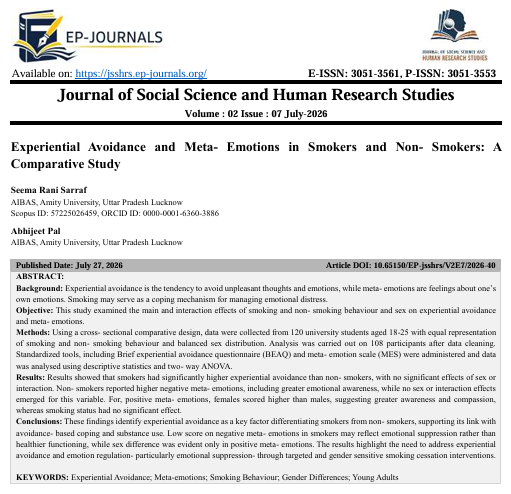
Experiential Avoidance and Meta- Emotions in Smokers and Non- Smokers: A Comparative Study
DOI:
https://doi.org/10.65150/EP-jsshrs/V2E7/2026-40Keywords:
Experiential Avoidance, Meta-emotions, Smoking Behaviour, Gender Differences, Young AdultsAbstract
Background: Experiential avoidance is the tendency to avoid unpleasant thoughts and emotions, while meta- emotions are feelings about one’s own emotions. Smoking may serve as a coping mechanism for managing emotional distress.
Objective: This study examined the main and interaction effects of smoking and non- smoking behaviour and sex on experiential avoidance and meta- emotions.
Methods: Using a cross- sectional comparative design, data were collected from 120 university students aged 18-25 with equal representation of smoking and non- smoking behaviour and balanced sex distribution. Analysis was carried out on 108 participants after data cleaning. Standardized tools, including Brief experiential avoidance questionnaire (BEAQ) and meta- emotion scale (MES) were administered and data was analysed using descriptive statistics and two- way ANOVA.
Results: Results showed that smokers had significantly higher experiential avoidance than non- smokers, with no significant effects of sex or interaction. Non- smokers reported higher negative meta- emotions, including greater emotional awareness, while no sex or interaction effects emerged for this variable. For, positive meta- emotions, females scored higher than males, suggesting greater awareness and compassion, whereas smoking status had no significant effect.
Conclusions: These findings identify experiential avoidance as a key factor differentiating smokers from non- smokers, supporting its link with avoidance- based coping and substance use. Low score on negative meta- emotions in smokers may reflect emotional suppression rather than healthier functioning, while sex difference was evident only in positive meta- emotions. The results highlight the need to address experiential avoidance and emotion regulation- particularly emotional suppression- through targeted and gender sensitive smoking cessation interventions
References
1) Aldao, A., Nolen Hoeksema, S., & Schweizer, S. (2010). Emotion-regulation strategies across psychopathology: A meta-analytic review. Clinical Psychology Review. 30, 217-237. doi: 10.1016/j. cpr.2009.11.004
2) Baker, T. B., Brandon, T. H., & Chassin, L. (2004). Motivational influences on cigarette smoking. Annual Review of Psychology, 55, 463-491. doi:10.1146/annurev.psych55.090902.142054
3) Barrett L F & Bliss-Moreau E. She’s emotional. He’s having a bad day: Attributional explanations for emotion stereotypes. Emotion. 2009; 9, 649–658. https://doi.org/10.1037/a0016821 PMID: 19803587
4) Bricker, J. B., Wyszynski, C. M., Comstock, B. A., & Heffner, J. L. (2013). Pilot randomized controlled trial of web-based acceptance and commitment therapy for smoking cessation. Nicotine & Tobacco Research, 15(10), 1756–1764.
5) Chaplin, T. M., & Aldao, A. (2013). Gender differences in emotion expression in children: A meta-analytic review. Psychological Bulletin, 139(4), 735–765. https://doi.org/10.1037/a0030737
6) Chawla, N., & Ostafin, B. (2007). Experiential avoidance as a functional dimensional approach to psychopathology: An empirical review. Journal of Clinical Psychology, 63, 871-890. doi: 10.1002/jclp.20400
7) Faulkner, P., Dean, A. C., Ghahremani, D. G., & London, E. D. (2020). Neural Basis of Smoking-Related Difficulties in Emotion Regulation. The international journal of neuropsychopharmacology, 23(7), 409–416. https://doi.org/10.1093/ijnp/pyaa015
8) Fischer A H. Sex differences in emotionality: Fact or stereotype? Feminism & Psychology. 1993; 3, 303–318.
9) Fischer, A.H., Kret, M.E. & Broekens, J. (2018). Gender differences in emotion perception and self-reported emotional intelligence: A test of the emotion sensitivity hypothesis. PLoS ONE 13(1): e0190712. https://doi.org/10.1371/journal.pone.0190712
10) Gámez, W., Chmielewski, M., Kotov, R., Ruggero, C., Suzuki, N., & Watson, D. (2014). The Brief Experiential Avoidance Questionnaire: Development and initial validation. Psychological Assessment, 26(1), 35–45. https://doi.org/10.1037/a0034473
11) Gifford, E. V., Kohlenberg, B. S., Hayes, S. C., Pierson, H. M., Piasecki, M. M., Antonuccio, D. O., & Palm, K. M. (2004). Acceptance-based treatment for smoking cessation. Behavior Therapy, 35(4), 689–705.
12) Givon, E., Berkovich, R., Oz-Cohen, E. et al. Are women truly “more emotional” than men? Sex differences in an indirect model-based measure of emotional feelings. Curr Psychol 42, 32469–32482 (2023). https://doi.org/10.1007/s12144-022-04227-z
13) Gottman, J. M., Katz, L. F., & Hooven, C. (1996). Parental meta-emotion philosophy and the emotional life of families: Theoretical models and preliminary data. Journal of Family Psychology, 10(3), 243–268. https://doi.org/10.1037/0893-3200.10.3.243
14) Hakulinen, C., Hintsanen, M., Munafo, M. R., Virtanen, M., Kivimäki, M., Batty, G. D., & Jokela, M. (2015). Personality and smoking: individual-participant meta-analysis of nine cohort studies. Addiction, 110(11), 1844-1852. https://doi.org/10.1111/add.13079
15) Hayes, S. C., Wilson, K. G., Gifford, E. V., Follette, V. M., & Strosahl, K. (1996). Experiential avoidance and behavioral disorders: A functional dimensional approach to diagnosis and treatment. Journal of Consulting and Clinical Psychology, 64(6), 1152–1168.
16) Horst Mitmansgruber, Thomas N. Beck, Stefan Höfer, Gerhard Schüßler, When you don’t like what you feel: Experiential avoidance, mindfulness and meta-emotion in emotion regulation, Personality and Individual Differences, Volume 46, Issue 4, 2009, Pages 448-453, ISSN 0191-8869, https://doi.org/10.1016/j.paid.2008.11.013.
17) Kashdan, T. B., Barrios, V., Forsyth, J. P., & Steger, M. F. (2006). Experiential avoidance as a generalized psychological vulnerability. Behaviour Research and Therapy, 44(9), 1301–1320.
18) Khantzian E. J. (1997). The self-medication hypothesis of substance use disorders: a reconsideration and recent applications. Harvard review of psychiatry, 4(5), 231–244. https://doi.org/10.3109/10673229709030550
19) Leyro, T. M., Zvolensky, M. J., & Bernstein, A. (2010). Distress tolerance and psychopathological symptoms and disorders: a review of the empirical literature among adults. Psychological bulletin, 136(4), 576–600. https://doi.org/10.1037/a0019712
20) Mankus, A. M., Boden, M. T., & Thompson, R. J. (2016). Sources of variation in emotional awareness: Age, gender, and socioeconomic status. Personality and individual differences, 89, 28–33. https://doi.org/10.1016/j.paid.2015.09.043
21) Miceli, M., & Castelfranchi, C. (2019). Anger and Its Cousins. Emotion Review, 11(1), 13-26.
22) Norman, E., & Furnes, B. (2016). The Concept of “Metaemotion”: What is There to Learn From Research on Metacognition? Emotion Review, 8(2), 187-193.
23) Plant E. A., Hyde J. S., Keltner D., & Devine P. G. (2000). The gender stereotyping of emotions. Psychology of Women Quarterly, 24, 81–92.
24) Shields SA. Gender in the psychology of emotion: A selective research review. In Strongman KT (Ed.), International Review of Studies on Emotion (pp. 227–245). 1991; New York: Wiley.
25) Tull, M. T., Gratz, K. L., Salters, K., & Roemer, L. (2004). The role of experiential avoidance in posttraumatic stress symptoms. Journal of Nervous and Mental Disease, 192(11), 754–761.
26) Wang, Y., Chen, X., Gong, J., & Yan, Y. (2016). Relationships Between Stress, Negative Emotions, Resilience, and Smoking: Testing a Moderated Mediation Model. Substance use & misuse, 51(4), 427–438. https://doi.org/10.3109/10826084.2015.1110176
Downloads
Published
Issue
Section
License
Copyright (c) 2026 Seema Rani Sarraf, Abhijeet Pal (Author)

This work is licensed under a Creative Commons Attribution 4.0 International License.