An Exploratory Look at Graduate Students’ Learning Strategies in Asynchronous Online Courses
DOI:
https://doi.org/10.65150/EP-jsshrs/V2E10/2026-14Keywords:
study strategies, retrieval practice, elaboration, dual coding, interleavingAbstract
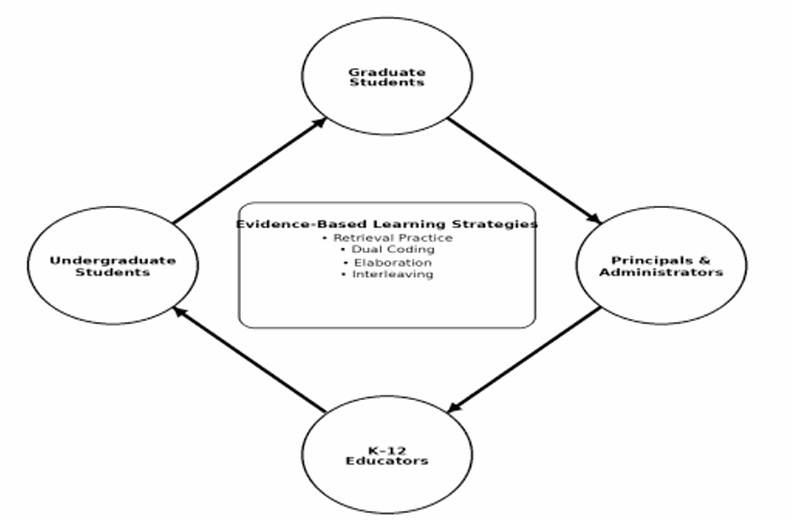
It is important that all students have a strong set of study strategies. This is especially true for graduate students in Education. These students frequently are, or are planning to be, administrators who. Principals are in a unique position to introduce study strategies to the teachers working under them. This, in turn, gives teachers a set of tools that they can pass on to their students. However, most students rely on strategies, such as rereading, that research shows to be less effective. Research has also identified numerous strategies that are advantageous for retaining studied information (e.g., Carpenter et al.; 2022). However, to put the strategies to use, teachers must know that they exist and when to use them. The current study examined how frequently graduate students in asynchronous online graduate courses use empirically validated research strategies. Specifically, the study focused on retrieval practice, elaboration, dual coding and interleaving. The results showed that the use of such strategies varies among students with interleaving being the most frequently used strategy and dual coding being the least used strategy.
References
1) Academic Affairs, University of Arizona. (n.d.). L2L Strategy - Elaboration. https://academicaffairs.arizona.edu/l2l-strategy-elaboration
2) Agarwal, P. K. (2019). Retrieval practice and Bloom’s taxonomy: Do students need fact knowledge before higher order learning? Journal of Educational Psychology 111, 189-209. http://pdf.poojaagarwal.com/Agarwal_2019_JEdPsych.pdf
3) Agarwal, P. K., & Bain, P. M. (2025). Powerful teaching: Unleash the science of learning. Jossey-Bass.
4) Baddley, A. (1982). Your Memory: A User’s guide. McMillian Publishing Company.
5) Bjork, R. A., Dunlosky, J., & Kornell, N. (2013). Self-regulated learning: Beliefs, techniques, and illusions. Annual Review of Psychology, 64(1), 417–444. https://doi.org/10.1146/annurev-psych-113011-143823
6) Brown, P. C., Roediger, H. L., & McDaniel, M. A. (2014). Make it stick: The science of successful learning. Harvard University Press.
7) Brunmair, M., & Richter, T. (2019). Similarity matters: A meta-analysis of interleaved learning and its moderators.Psychological Bulletin, 145(11), 1029-1052. https://doi.org/10.1037/bul0000209
8) Carpenter, S. K., Pan, S. C., & Butler, A. C. (2022). The science of effective learning with spacing and retrieval practice. Nature Reviews: Psychology, 1, 496-511. https://www.nature.com/articles/s44159-022-00089-1
9) Crede, M, & Kuneel, N. R. (2008). Study habits, skills, and attitudes: The third pillar supporting collegiate academic performance, Perspectives on Psychological Science, 3(6), 425-453.
10) Dong, J., Li, X., XU, Y., Yang, G., & Wang, X. (2022). Dual encoding for video retrieval by text. Transactions on Pattern Analysis and Machine Learning, 44(8) 4065-4080.
11) Dunlosky, J., Rawson, K. A., Marsh, E. J., Nathan, M. J., & Willingham, D. T. (2013,September/October). What works, what doesn’t. Scientific American. https://www.scientificamerican.com/article/what-works-what-doesn-t/
12) Eglington, L.G. & Kang, S.H. (2017) Interleaved presentation benefits science category learning. Journal of Applied Research inMemory and Cognition, 6, 475–485. https://doi.org/10.1016/j.jarmac.2017.07.005
13) Fazal, S., Hussain, S., Majoka, M. I., & Masood, S. (2012). The role of study skills in academic achievement of students: A closer focus on gender. Pakistan Journal of Psychological Research, 27(1), 37-51.
14) Feiyue, Z. (2022). Edutainment methods in the learning process: Quickly, fun, and satisfying. Intenational Journal of Environment, Engineering and Education, 4(1),19-26, 2022. https://doi.org/10.55151/ijeedu.v4i1.41
15) Finch, A. (2025). Mastering elaboration study techniques for better retention and recall.https://learnwisedaily.com/mastering-elaboration-study-technique-for-better-retention-and-recall/
16) Fiorella, L., & Mayer, R. E. (2016). Eight ways to promote generative learning. Educational Psychology Review, 28(4), 717–741. https://doi.org/10.1007/s10648-015-9348-9
17) Fong, C. J., Warner, J. R., Williams, K. M., Schallert, D. L., Chen, L-H., Williamson, Z. H., &
18) Lin, S. (2016). Deconstructing constructive criticism: The nature of academic emotions associated with constructive, positive, and negative feedback, Learning and Individual Differences,49, 393-399, https://doi.org/10.1016/j.lindif.2016.05.019
19) Fordyce, A. L., Redick T. S., Bedwell, J. P., & Karpicke, J. D. (2025). Individual differences in working memory and the benefit
20) of retrieval practice, Journal of Memory and Language (144), https://doi.org/10.1016/j.jml.2025.104664
21) Fouche, J. P. (2017). The reported study habits and time-management trends of post-graduate students in accountancy. South African Journal of Higher Education, 31(6), 197-217. http://dx.doi.org/10.28535/31-6-1356
22) Gentry, R. (2012). Making college a success by assessing and navigating candidates’ study habits. Research in Higher Education Journal, 18, 1-13.
23) Goedhart, C. (2021). Activating student metacognitions: How to help students learn more effectively and efficiently. Bio News. https://blogs.ubc.ca/bionews/2021/02/activating-student-metacognition-how-to-help-students-learn-more-effectively-and-efficiently/
24) Gurung, R. A. R. (2005). How do students really study (and does it matter)? Teaching of Psychology, 32(4), 239–241.
http://doi.org/10.1207/s15328023top3204_8
25) Hadwin, L. (2022). Practical Applications for Cognitive Strategies in the College Classroom.The Teaching Professor. https://www.teachingprofessor.com/topics/teaching-strategies/practical-applications-for-cognitive-strategies-in-the-college-classroom/
26) Hassanbeigi, A., Askari, J., Nakhjavani, M., Shirkhoda, S., Barzegar, K., Mozayyan, M. R., & Fallahzadeh, H. (2011). The relationship between study skills and academic performance of university students. Procedia - Social and Behavioral Sciences, 30, 416–1424. http://doi:10.1016/j.sbspro.2011.10.276
27) Hawthorne, M. J., Cooper, A., Chavis, K., Burrell, T., & Evans, C. (2021). Ability and responsibility: Need for Cognition and study habits in academic achievement. Research in Higher Education, 39, https://www.aabri.com/manuscripts/203306.pdf
28) Karpicke, J. D. (2006). Retrieval-based learning: Active retrieval promotes meaningful learning. Current Directions in Psychological Science, 21(3), 157-163. https://www.jstor.org/stable/23213127
29) Karpicke, J. D. & Blunt, J. R. (2011). Retrieval practice produces more learning than elaborative studying with concept mapping. Science, 331(6018), 772–775. https://doi.org/10.1126/science.1199327
30) Kirschner, P. A., & Hendrick, C. (2020) How Learning Happens: Seminal works in educational psychology and what they mean in practice. Routledge.
31) Kornell, N. & Bjork, R.A. (2008) Learning concepts and categories: Is spacing the ‘enemy of induction’?, Psychological Science, 19, 585–592. https://doi.org/10.1111j.1467-9280.2008.02127.x
32) Lang, J. M. (2016). Small teaching: Everyday lessons from the science of learning. Josey-Bass.
33) Lei, S. (2015). Variation in study patterns among college students: A review of literature. College Student Journal, 49(2), 195-198.
34) Malamed, C. (2021). Elaboration strategies benefit learning: Making connections to prior knowledge. The eLearning Coach. https://theelearningcoach.com/learning/elaboration-theory/
35) McCain, J. L., Hawthorne, M. J., Young-Jones, A., Pierce, B. H., & Smith, T. (2018) First-generation and non-first-generation students: A multi-factor exploration of undergraduate success. The Journal of College Orientation and Transition, 25(2). 15-41.
https://pubs.lib.umn.edu/index.php/jcotr/article/view/2118
36) McDermott, K. B. (2021). Practicing retrieval facilitates learning. Annual Review of Psychology, 72(1), 609–633.
https://doi.org/10.1146/annurev-psych-010419-051019
37) McGinley, B., Carlson, N., & Hoppe, E. (2008). What were they thinking? Surveying study practices of entering students. Optometric Education, 33(2), 59-63. Retrieved from http://journal.opted.org/
38) Morehead, K., Rhodes, M. G., & DeLozier, S. (2016). Instructor and student knowledge of study strategies. Memory, 24(2), 257–271. http://doi.org/10.1080/09658211.2014.1001992
39) Onwuegbuzie, A. J., Slate, J. R., & Schwartz, R. A. (2001). Role of study skills in graduate-level research courses. The Journal of Educational Research, 94(4). 238-246.http://www.jstor.org/stable/27542328
40) Open Library. (n.d.). Supporting interleaving.
41) Parrish, N. (2022, May 5). How to get students thinking about their own learning. https://www.edutopia.org/article/how-get-students-thinking-about-their-own-learning
42) Paivio, A. (1990). Mental Representations: A dual coding approach. Oxford University Press.
43) Pan S. C., & Rickard, T.C. (2018). Transfer of test-enhanced learning: Meta-analytic review and synthesis. Psychological Bulletin, 144(7),710-756. https://doi.org/10.1037/bul0000151
44) Rawson, K.A., Thomas, R.C. & Jacoby, L.L. (2015) The power of examples: Illustrative examples enhance conceptual learning of declarative concepts, Educational Psychology Review, 27, 483–504. https://doi.org/10.1007/s10648-014-9273-3.
45) Roediger, H. L. & Karpicke, J. D. (2006). Test-enhanced learning: taking memory tests improves long-term retention. Psychological Science, 17(3), 249-55. https://doi.org/10.1111/j.1467-9280.2006.0169
46) Rohrer, D., Dedrick, R.F. & Burgess, K. (2014) The benefit of interleaved mathematics practice is not limited to superficially similar kinds of problems. Psychonomics Bulletin Review (21), 1323–1330. https://doi.org/10.3758/s13423-014-0588-3
47) Rosenshine, B. (2012). Principles of instruction: Research-based strategies that all teachers should know. American Educator, 36(1), 12-19. https://eric.ed.gov/?id=EJ971753
48) Ruffin, M. A., Tudor, R. N., & Beier, M. E. (2024). Prompting Strategy Use and Beyond: Examining the Relationships betweenElaboration, Quantity, and Diversity of Learning Strategies on Performance. Behavioral sciences (Basel, Switzerland), 14(9), 764. https://doi.org/10.3390/bs14090764
49) Shin, H-I, Jeon, T. W., & Yang, E. B. (2010). Relationship between learning strategies and academic achievement in medical college and graduate medical school students. Korean Journal of Medical Education, 22(3), 197-204. doi: 10.3946/kjme.2010.22.3.197
50) Singer, B. D., & Mogensen, J. (2021). Getting students to self-advocate—Step by Step.
https://leader.pubs.asha.org/do/10.1044/leader.FTR1.26082021.32/full/
51) Smith, M., & Weinstein, Y. (2025). Learn how to study using …elaboration.https://www.learningscientists.org/blog/2016/7/7-1
Downloads
Published
Issue
Section
License
Copyright (c) 2026 Cassandra Williams, Kristi Young, Dionne Williams, Joyce Farrow, Melissa J. Hawthorne (Author)

This work is licensed under a Creative Commons Attribution 4.0 International License.