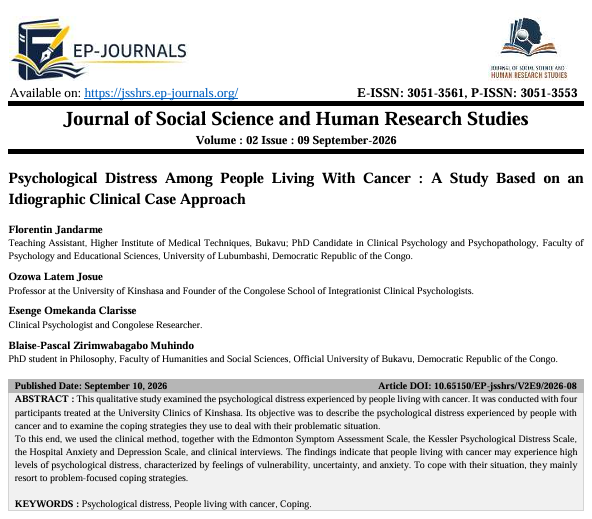
Psychological Distress Among People Living With Cancer : A Study Based on an Idiographic Clinical Case Approach
DOI:
https://doi.org/10.65150/EP-jsshrs/V2E9/2026-08Keywords:
Psychological distress, People living with cancer, CopingAbstract
This qualitative study examined the psychological distress experienced by people living with cancer. It was conducted with four participants treated at the University Clinics of Kinshasa. Its objective was to describe the psychological distress experienced by people with cancer and to examine the coping strategies they use to deal with their problematic situation.
To this end, we used the clinical method, together with the Edmonton Symptom Assessment Scale, the Kessler Psychological Distress Scale, the Hospital Anxiety and Depression Scale, and clinical interviews. The findings indicate that people living with cancer may experience high levels of psychological distress, characterized by feelings of vulnerability, uncertainty, and anxiety. To cope with their situation, they mainly resort to problem-focused coping strategies.
References
1) Annales Médico-Psychologiques. (2017). Prise en charge psychologique de patient cancéreux. Revue Psychiatrique, 175(3), 241–246.
2) Bézy, O., & Jalenques, L. (2007). De la spécificité du cancer et de ses effets. Annales Médico-Psychologiques, 165, 132–135.
3) Fischer, G. N. (2013). Psychologie de la santé : un autre regard sur la maladie et guérison. Paris: Odile Jacob.
4) Frank, A. W. (1995). The wounded storyteller: Body, illness, and ethics. University of Chicago Press.
5) Holland, J. C., & Breitbart, W. S. (Eds.). (2015). Psycho-oncology (3rd ed.). Oxford University Press.
6) Jolly, C. (2018). Impact du cancer sur la psychologie et l’identité féminine des patientes [Master’s thesis in Psychology, Catholic University of Louvain]. https://dial.uclouvain.be/memoire/ucl/fr/object/thesis%3A15791
7) Lazarus, R. S., & Folkman, S. (1984). Stress, appraisal, and coping. Springer Publishing Company.
8) Lelo, C., & Saka, L. (2019). À quand un programme national de lutte contre le cancer en RDC ? https://habarirdc.netquand-programmenational
9) Mawisa, E. (2020). Traumatisme psychique chez les enfants de la rue [Master’s thesis in Clinical Psychology, Faculty of Psychology and Educational Sciences, University of Kinshasa].
10) Ndahindwa, V., Ngendahayo, L., & Vyankandondera, J. (2012). Aspects épidémiologiques et anatomopathologiques des cancers dans les centres hospitaliers universitaires du Rwanda. Revue Médicale Rwandaise, 5, 44–49.
11) Nordmann-Dolbeaut, S. (2009). La détresse des patients atteints de cancer : prévalences, facteurs prédictifs, modalités de repérage et de prise en charge [Doctoral dissertation in Neuroscience, University of Paris].
12) World Health Organization. (2014). Principaux faits sur le cancer dans le monde, ses causes. https://www.who.int/fr/news-room/fact-sheets/detail/cancer
13) Park, C. L. (2010). Making sense of the meaning literature: An integrative review of meaning-making and its effects on adjustment to stressful life events. Psychological Bulletin, 136(2), 257–301. https://doi.org/10.1037/a0018301
14) Puchalski, C. M., Vitillo, R., Hull, S. K., & Reller, N. (2014). Improving the spiritual dimension of whole-person care: Reaching national and international consensus. Journal of Palliative Medicine, 17(6), 642–656. https://doi.org/10.1089/jpm.2014.9427
15) Roy, S. (2013). Le psychologue et le cancéreux. Le Figaro.
16) Tribolet, S., & Shahidi, M. (2005). Nouveau précis de sémiologie des troubles psychiques. Paris: Éditions Heures de France.
17) Yalom, I. D. (1980). Existential psychotherapy. Basic Books.
Downloads
Published
Issue
Section
License
Copyright (c) 2026 Florentin Jandarme, Ozowa Latem Josue, Esenge Omekanda Clarisse, Blaise-Pascal Zirimwabagabo Muhindo (Author)

This work is licensed under a Creative Commons Attribution 4.0 International License.