A Study on Modern Clothing Care and Management Practices in the Tamale Metropolis of Ghana
DOI:
https://doi.org/10.65150/EP-jsshrs/V2E9/2026-12Keywords:
Clothing care practices, Care labels, Clothing management, Laundering, Clothing storage, Garment repair, Consumer awareness, Tamale Metropolis (Ghana)Abstract
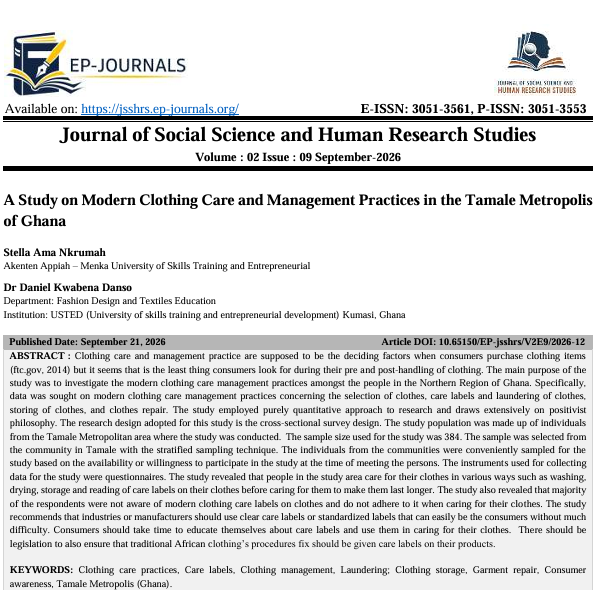
Clothing care and management practice are supposed to be the deciding factors when consumers purchase clothing items (ftc.gov, 2014) but it seems that is the least thing consumers look for during their pre and post-handling of clothing. The main purpose of the study was to investigate the modern clothing care management practices amongst the people in the Northern Region of Ghana. Specifically, data was sought on modern clothing care management practices concerning the selection of clothes, care labels and laundering of clothes, storing of clothes, and clothes repair. The study employed purely quantitative approach to research and draws extensively on positivist philosophy. The research design adopted for this study is the cross-sectional survey design. The study population was made up of individuals from the Tamale Metropolitan area where the study was conducted. The sample size used for the study was 384. The sample was selected from the community in Tamale with the stratified sampling technique. The individuals from the communities were conveniently sampled for the study based on the availability or willingness to participate in the study at the time of meeting the persons. The instruments used for collecting data for the study were questionnaires. The study revealed that people in the study area care for their clothes in various ways such as washing, drying, storage and reading of care labels on their clothes before caring for them to make them last longer. The study also revealed that majority of the respondents were not aware of modern clothing care labels on clothes and do not adhere to it when caring for their clothes. The study recommends that industries or manufacturers should use clear care labels or standardized labels that can easily be the consumers without much difficulty. Consumers should take time to educate themselves about care labels and use them in caring for their clothes. There should be legislation to also ensure that traditional African clothing’s procedures fix should be given care labels on their products.
References
1) Amedahe, F. K. & Asamoah-Gyimah, E. (2005). Introduction to educational research. Accra-North: Mercury Press (Centre for Continuing Education of the University of Cape Coast.
2) Anyakoha, E, U. & Eluwa, A. S. (2007). Home management for schools and colleges.
3) Anyakola, E, V. & Eluwa, A., S. (2005). The management of construction company overhead costs. International Journal of Project Management, 19, 295-303 p2.
4) Asamoah-Gyimah, K. & Duodu, F. (2006). Introduction to research methods in education. Winneba: I. E. D. E., U. E. W.
5) AATC Technical Manual (2010). Overview of liquid fabric softners used in home making. New York, Howe's Publishing Co., Inc
6) Babbie, E. & Mouton, J. (2004). The practice of social research. Oxford University Press.
7) Bain, J., Beton, A., Schultze, A., Mudgal, S., Dowling, M. & Holdway, R. (2009). Reducing the environmental impact of clothes cleaning: A research report completed for DEFRA. London: BIO intelligence Service in collaboration with Giraffe and Intertek.
8) Barnes, S. H. (1955). Preferences and practices in the purchase, use and care of clothing of 225 junior high school students in Zanesville, Ohio. Ohio, Ohio State University, unpublished M.Sc. thesis.
9) Barsalou, L. W. (1999). Perceptual symbol systems. Behavioral and Brain Sciences, 22(4), 577–609.
10) Burke, R. J. & Christensen, L. B. (2008). Education Research: Quantitative, qualitative, and mixed approaches (3rded). London: Sage Publications.
11) Cant, M. C., Brink, A., & Brijball, S. (2006). Consumer behaviour. Juta.
12) Cohen, L., Manion, L. & Morrison, K. (2000). Research methods in education (5th ed.). RoutledgeFalmer.
13) Cooper, T., Fisher, T., Hiller, A., Goworek, H., & Woodward, S. (2010). Excessive speed/short lives: Attitudes to clothing longevity and disposal. In F. Ceschin, C. Vezzoli, & J. Zhang (Eds.), Proceedings of the LeNS Conference: Sustainability in Design – Now! (pp. 728–737). Greenleaf Publishing.
14) Das, A. B., & Bhattacharyya, R. (2014). See Ghosh, Das, & Bhattacharyya (2014) below; the in-text citation should read (Ghosh, Das & Bhattacharyya, 2014), matching the reference entry: Ghosh, S. K., Das, A. B., & Bhattacharyya, R. (2014). Care label issues of silk fabric. International Journal of Research in Engineering and Technology, 3(7), 176–179.
15) De Klerk, H. M., & Lubbe, S. (2008). Female consumers' evaluation of apparel quality: Exploring the importance of aesthetics. Journal of Fashion Marketing and Management, 12(1), 36–50.
16) Ekström, K. M., Gustafsson, E., Hjelmgren, D., & Salomonson, N. (2012). Mot en mer hållbar konsumtion: En studie om konsumenters anskaffning och avyttring av kläder [Towards a more sustainable consumption: A study of consumers' acquisition and disposal of clothing] (Vetenskap för profession, 20:2012). University of Borås.
17) Fisher, T., Cooper, T., Woodward, S., Hiller, A., & Goworek, H. (2008). Public understanding of sustainable clothing: A report to the Department for Environment, Food and Rural Affairs. Defra.
18) Gracey, F., & Moon, D. (2012). Valuing our clothes: The evidence base. WRAP.
19) Hoyer, W. D., & MacInnis, D. J. (2008). Consumer behavior (5th ed.). South-Western Cengage Learning.
20) Fletcher, K.; Klepp, I. G. (2017). Opening Up the Wardrobe: A Methods Book; Novus: Oslo, Norway, p. 195.
21) Gay, L. R. (1992). Education research: Competencies for analyses and adaptation (4th ed.). McGraw Hill Inc.
22) Gay, L. R., & Airasian, P. (2003). Educational research: Competencies for analysis and application (7th ed.). Pearson Education.
23) Gram-Hanssen, K. (2008). Consuming technologies: Developing routines. Journal of Cleaner Production, 16, 1181-1189.
24) Herale, J. W. S. (1971). The nature of setting, chapter: 1 in setting of fibre and fabrics. Watford, Merrow Publishing Co.
25) Higgins, L., Anand, S. C., Holmes, D. A., Hall, M. E. & Underly, K. (2003). Effect of various home laundering practices on the dimensional stability, wrinkling and other properties of plain-woven cotton fabrics part I: Experimental overview, reproducibility of results and effect of detergent. Textile Research Journal, 73, 357-366.
26) Higgins, L., Anand, S. C., Hall, M. E., Holmes, D. A. & Brown, K. (2001). Effects of repeated laundering on dimensional stability and distortion of soft knitted cotton fabrics. In AIT conference proceedings, Colombus, Ohio
27) Jone, G. (1990). Finding out about textiles. Stanley thorns Publishing Ltd.
28) Kish, L. (1965). Survey sampling. John Wiley & Sons, Inc.
29) Koester, A. M. & May, J. K. (1985). Profiles of adolescents' clothing practices: Purchase, daily selection, and care. Adolescence, 20 (77), 97-113.
30) Laitala, K., Kirsi, L., Ingun, P., Klepp, G. & Hauge, B. (2011). Matierialised Ideals: Size and beauty. Culture Unbound, 3, 19-41.
31) Laitala, K., Boks, C. & Klepp, I. G. (2011). Potential for environmental improvements in laundering. International Journal of Consumer Studies, 35, 254-264.
32) Kaiser, S. (1990). The social psychology of clothing. Macmillan Publishing Company.
33) Kathleen, M. J. (2005). Taking care of your clothes. Retrieved on October16, 2014 from http://www.joe.org/joe/rb2.html.me
34) Klepp, I.G.; Bjerck, M. A (2014). methodological approach to the materiality of clothing: Wardrobe Studies. Int. J. Soc. Res. Methodol. 17, 373–386.
35) Klepp, I. G. (2007). Patched, Louse-Ridden, Tattered: Clean And Dirty Clothes. Text. J. Cloth Cult. 5, 254–275.
36) Kim, J.; Park, Y.; Yun, C.; Park, C.H. (2015). Comparison Of Environmental And Economic Impacts Caused By The Washing Machine Operation Of Various Regions. Energy Effic. 8, 905–918.
37) Kusi, H. (2012). Doing qualitative research:A guide for researcher.Accra Newtown: Emmpong Press.
38) Laitala, K., Boks, C., & Klepp, I. G. (2011a). Potential for environmental improvements in laundering. International Journal of Consumer Studies, 35(2), 254.
39) Lindén A-L, Carlsson-Kanyama A, Eriksson B. (2006). Efficient and inefficient aspects of residential energy behaviour: What are the policy instruments for change? Energy Policy, 34, 1918-1927.
40) Madsen, J.; Hartlin, B.; Perumalpillai, S.; Selby, S.; Aumônier, S. (2007). Mapping of Evidence on Sustainable Development Impacts That Occur in Life Cycles of Clothing: A Report to Defra; Environmental Resources Management Ltd.
41) Marshal, H., Suzanne, G., Jackson, O. H., Stanley, S. M., Kegan, M. & TouchieSpecnt, P. (2000). Individuality in Clothing selection and Personal Appearance. Prentice Hall.
42) Mitchell, M. L. & Jolley, J. M. (2004). Handbook of methods in social psychology. Thousand Oaks: The Sage.
43) Nathan, K. (2009). The impact of Internet Communication Technology (ICT) in rural education: Case study. Nigeria Journal of Technology, 28 (2), 71-79.
44) Neuman, W. L. (2000). Social research methods: Qualitative and quantitative approaches. Allyn and Bacon.
45) Ohwvoriole, P. I. & Ugeru, E. (2002). Problems of clothing management practices of home makers: Research issues in Home Economics. Nsukka: ECCE Homo Enterprises.
46) Okoro, O. M. (1999). Principles and methods in vocational and technical education. University Trust Publisher.
47) O’Leary, A. (2004). The essential guide to doing research. SAGE Publications.
48) Onasch, J. A (2011). Feasibility and cost comparison of perchloroethylene dry cleaning to professional wet cleaning: Case study of Silver Hanger Cleaners, Bellingham, Massachusetts. J. Clean. Prod. 2011, 19, 477–482.
49) Ozarda, B. T., Moore, M. A., Collier, B. J. & Chen, J. Y. (2009). Effect of laundering on fabric drape, bending and shear. International Journal of Clothing Science and Technology, 21 (1), 44-55.
50) Pakula, C., & Stamminger, R. (2010). Electricity And Water Consumption For Laundry Washing By Washing Machine Worldwide. Energy Effic. 3, 365–382.
51) Quaynor, L. Takahashi, M., & Nakajima, M. (2000). Effects of laundering on the surface properties and dimensional stability of plain knitted fabrics. Textile Research Journal, 70, 28-35.
52) Schinder, W. D. & Hauser, P. J. (2004). Softening finishes: Chemical finishes of textiles. Woodhead Publishing Ltd, 29-42.
53) Shove E. (2003). Comfort, cleanliness and convenience: The social organization of normality. Oxford, Berg.
54) Storm, P. (1987). Functions of dress. Prentice- Hall.
55) Sugiyono, (2011). Metodepenelitiankuantitatif, kualitatif, dankombinasi (Mixed method). CV. Alfabeta.
56) Throne-Holst, H., Stø, E. & Strandbakken, P. (2007). The role of consumption and consumers in zero emission strategies. Journal of Cleaner Production; 15, 1328-1336.
57) Tuckman, B. W. (1992). Conducting educational research. Harcourt Brace Jovanovich, Inc.
58) WoodWard (2006). Clothing care and sewing techniques for visually impaired on total blind student’s home making teacher. Retrieved on Septeber 8, 2014 from Com.http://home.home. how stuffoncom/how-to-care-for-your-clothes.htm.
59) Yin, R. K. (2003). Case study research design and methods. Applied social research methods series (3rd ed.). Sage.
Downloads
Published
Issue
Section
License
Copyright (c) 2026 Stella Ama Nkrumah (Author)

This work is licensed under a Creative Commons Attribution 4.0 International License.