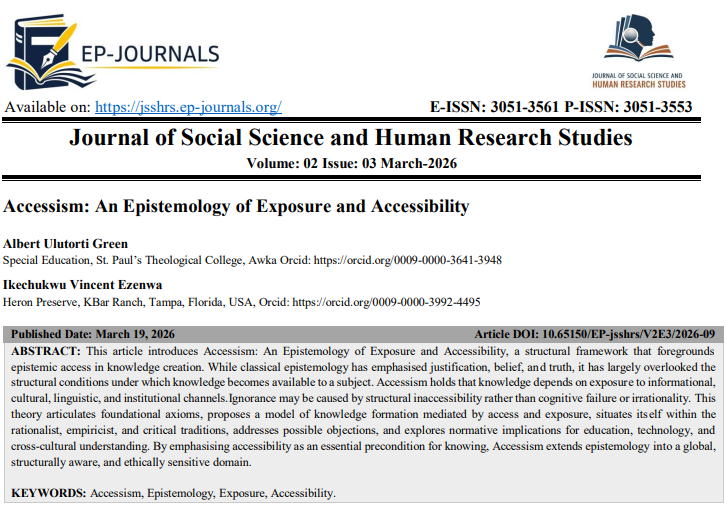
Accessism: An Epistemology of Exposure and Accessibility
DOI:
https://doi.org/10.65150/EP-jsshrs/V2E3/2026-09Keywords:
Accessism, Epistemology, Exposure, Accessibility.Abstract
This article introduces Accessism: An Epistemology of Exposure and Accessibility, a structural framework that foregrounds epistemic access in knowledge creation. While classical epistemology has emphasised justification, belief, and truth, it has largely overlooked the structural conditions under which knowledge becomes available to a subject. Accessism holds that knowledge depends on exposure to informational, cultural, linguistic, and institutional channels.Ignorance may be caused by structural inaccessibility rather than cognitive failure or irrationality. This theory articulates foundational axioms, proposes a model of knowledge formation mediated by access and exposure, situates itself within the rationalist, empiricist, and critical traditions, addresses possible objections, and explores normative implications for education, technology, and cross-cultural understanding. By emphasising accessibility as an essential precondition for knowing, Accessism extends epistemology into a global, structurally aware, and ethically sensitive domain.
References
1) Alican, N. F. (2022). What’s So Good About the Good Will? An Ontological Critique of Kant’s Axiomatic Moral Construct.
2) Angwaomaodoko, E. A. (2023). An appraisal on the role of technology in modern education, opportunities and challenges. Traektoriâ Nauki, 9(12), 3019-3028.
3) Capps, J. (2024). Epistemology, logic, and inquiry. The bloomsbury handbook of pragmatism, 101.
4) Chang, H. (2022). Realism for realistic people. Cambridge University Press.
5) Currie, A. (2023). Epistemic engagement, aesthetic value, and scientific practice. The British Journal for the Philosophy of Science, 74(2), 313-334.
6) Descartes, R. (2016). Meditations on first philosophy. In Seven masterpieces of philosophy (pp. 63-108). Routledge.
7) Farzanfar, D., Spiers, H. J., Moscovitch, M., & Rosenbaum, R. S. (2023). From cognitive maps to spatial schemas. Nature Reviews Neuroscience, 24(2), 63-79.
8) Fricker, M. (2007). Epistemic injustice: Power and the ethics of knowing. Oxford university press.
9) Gaines, B. R. (1989). Social and cognitive processes in knowledge acquisition. Knowledge Acquisition, 1(1), 39-58.
10) Gettier, E. L. (1963). Is justified true belief knowledge?
11) Giuseffi, F. (2024). The Investigation of a Nelsonian Approach to Socratic Dialogue with Student-Teachers at a Midwestern Private University. InSight: A Journal of Scholarly Teaching, 20, 1.
12) Hume, D. (2016). An enquiry concerning human understanding. In Seven masterpieces of philosophy (pp. 183-276). Routledge.
13) Ihejirika, C. (2024). Harnessing African indigenous knowledge systems for knowledge production: A redefinition of a culture-centric epistemology. Journal of Contemporary Philosophical and Anthropological Studies, 2(1).
14) Kant, I. (1998). of pure reason (1781). Translated by: NK Smith, URL: http://staffweb. hkbu. edu. hk/ppp/cpr/toc. html.
15) Locke, J. (2022). An Essay Concerning Human Understanding. Volume One (Vol. 1). Lindhardt og Ringhof.
16) Mazzulla, G., & Pirrone, C. G. (2024). Accessibility measures: from a literature review to a classification framework. ISPRS International Journal of Geo-Information, 13(12), 450.
17) Moberger, V. (2022). The truth about objective truths. Free Inquiry, 42(6), 50-52.
18) Morrison, H., & Rahman, A. (2020). Knowledge and equity: analysis of three models.
19) Oeberst, A., & Imhoff, R. (2023). Toward parsimony in bias research: A proposed common framework of belief-consistent information processing for a set of biases. Perspectives on Psychological Science, 18(6), 1464-1487.
20) Shin, H. S. (2019). Reasoning processes in clinical reasoning: from the perspective of cognitive psychology. Korean journal of medical education, 31(4), 299.
21) Smalle, E. H., Daikoku, T., Szmalec, A., Duyck, W., & Möttönen, R. (2022). Unlocking adults’ implicit statistical learning by cognitive depletion. Proceedings of the National Academy of Sciences, 119(2), e2026011119.
22) Smith, E. R., & DeCoster, J. (1998). Knowledge acquisition, accessibility, and use in person perception and stereotyping: Simulation with a recurrent connectionist network. Journal of personality and social psychology, 74(1), 21.
23) Tanesini, A. (2025). Social Epistemology: The Niches for Knowledge and Ignorance. John Wiley & Sons.
24) Uchihara, T., Webb, S., Saito, K., & Trofimovich, P. (2023). Frequency of exposure influences accentedness and comprehensibility in learners’ pronunciation of second language words. Language Learning, 73(1), 84-125.
25) Yao, Y., Wang, K., & Xiang, H. (2022). Association between cognitive function and ambient particulate matters in middle-aged and elderly Chinese adults: Evidence from the China Health and Retirement Longitudinal Study (CHARLS). Science of the Total Environment, 828, 154297.
Downloads
Published
Issue
Section
License
Copyright (c) 2026 Albert Ulutorti Green, Ikechukwu Vincent Ezenwa (Author)

This work is licensed under a Creative Commons Attribution 4.0 International License.