Legal Impact for Former Landowners After the Determination of Destroyed Land on the Semarang-Demak Expressway Project Section 1
DOI:
https://doi.org/10.65150/EP-jsshrs/V2E9/2026-17Abstract
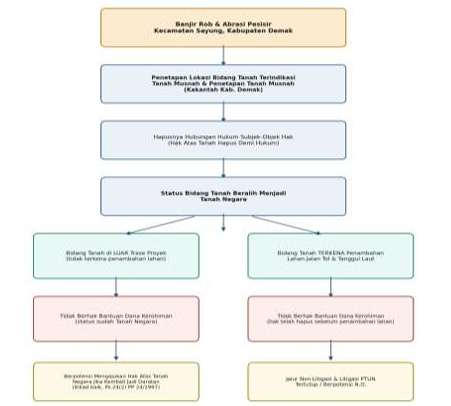
This study examines the legal consequences that arise for former landowners, both for the affected land plots and the remaining land plots that are not affected by the construction project of the Semarang-Demak Section 1 Freeway and its sea embankments, after the issuance of the determination of the location of the land plots indicated as destroyed land and the determination of the destroyed land itself. The phenomenon of land destruction along the coast of Sayung District, Demak Regency arose due to tidal floods and seawater abrasion that had permanently changed the physical shape of the land, thus having an impact on the removal of the community's civil rights, including Property Rights, over the land they once controlled. This study uses empirical legal research methods with ontology, epistemology, and axiology approaches, supported by primary data in the form of interviews and observations at the Demak Regency Land Office, the Regional Office of the Ministry of ATR/BPN of Central Java Province, the Commitment Making Officer for the Land Acquisition of the Freeway, and the Public Housing and Settlement Office of Central Java Province, as well as secondary data in the form of related laws and regulations. The results of the study show that the land that has been designated as land is destroyed, both inside and outside the project trajectory, losing the legal relationship between the subject and the object of his rights, so that the right to the land is abolished for the sake of law and changes the status to state land. Consequently, former landowners outside the project trajectory are no longer entitled to the Kerohiman Fund Assistance, while for those whose fields are affected by land addition projects, these rights cannot be restored either through non-litigation or state administrative litigation, considering the potential for state financial losses if compensation is still given. This study recommends the need for comprehensive policies to accommodate the social justice interests of affected coastal communities without ignoring the principles of legal certainty and state financial protection.
References
1) Alfiana, Alfin Afridha. (2026). Analisis Perubahan Penggunaan Tanah Pada Kawasan Tanah Musnah di Pesisir Pulau Jawa. Studi Kasus Kecamatan Sayung, Kabupaten Demak. Yogyakarta: Politeknik Agraria STPN.
2) Amiruddin dan Zainal Asikin. (2003). Pengantar Metode Penelitian Hukum. Jakarta: RajaGrafindo Persada.
3) Soekanto, Soerjono. (1984). Pengantar Penelitian Hukum. Jakarta: Universitas Indonesia Press.
4) Kelsen, Hans. Teori Hukum Murni (Pure Theory of Law).
5) Salim, M. Afif, dkk. (2023). Kajian Wilayah Pesisir dan Mitigasi Banjir Rob.
6) Khairullah, dkk. (2024). Fenomena Banjir Rob dan Penurunan Muka Tanah di Pesisir Pantura.
7) Zhafira & Asyura. (2025). Abrasi Pesisir Demak dan Faktor Geomorfologi.
8) Asih Retno Dewi, Rosye, Imbiri. (2023). Kebijakan Pengaturan Tanah Musnah Belajar Dari Pengadaan Tanah Untuk Jalan Tol Semarang Demak Terintegrasi Tanggul Laut. Laporan Penelitian. Yogyakarta: STPN, PPPM.
9) Rahmat Riyadi, dkk. (2023). Perumusan Pengaturan Tanah Musnah: Kondisi, Penyebab dan Konsekuensinya (Studi Kasus Penetapan Tanah Musnah di Kabupaten Bogor). Yogyakarta: STPN, PPPM.
10) Reza Arief. (2023). Perlindungan Hukum Bagi Pemilik Tanah yang Kehilangan Hak Tanahnya Akibat Perubahan Kontur Sungai. Skripsi. repo-mhs.ulm.ac.id.
11) Satriya Parama Putra Wibawa. (2023). Kelayakan Nilai Dana Kerohiman Sebagai Penanganan Dampak Sosial Tanah Musnah Pada Pengadaan Tanah Untuk Pembangunan Jalan Tol Semarang-Demak. Skripsi.
12) Kementerian PU. (2020). Spesifikasi Umum untuk Jalan Bebas Hambatan dan Jalan Tol. Jakarta: Kementerian PUPR, Ditjen Bina Marga.
13) Direktorat Jenderal Bina Marga Kementerian PUPR. (2021). Laporan Proyek Jalan Tol Semarang-Demak: Progres dan Penanganan Isu Lahan. Jakarta: Ditjen Bina Marga.
14) Undang-Undang Nomor 5 Tahun 1960 tentang Peraturan Dasar Pokok-Pokok Agraria.
15) Undang-Undang Nomor 38 Tahun 2004 tentang Jalan.
16) Undang-undang (UU) Nomor 2 Tahun 2022 tentang Perubahan Kedua atas Undang-Undang Nomor 38 Tahun 2004 tentang Jalan
17) Undang-Undang Nomor 2 Tahun 2012 tentang Pengadaan Tanah Bagi Pembangunan Untuk Kepentingan Umum.
18) Undang-Undang Nomor 30 Tahun 2014 tentang Administrasi Pemerintahan.
19) Undang-Undang Nomor 5 Tahun 1986 tentang Peradilan Tata Usaha Negara sebagaimana diubah dengan Undang-Undang Nomor 9 Tahun 2004 dan Undang-Undang Nomor 51 Tahun 2009.
20) Peraturan Pemerintah Nomor 24 Tahun 1997 tentang Pendaftaran Tanah.
21) Peraturan Pemerintah Nomor 18 Tahun 2021 tentang Hak Pengelolaan, Hak Atas Tanah, Satuan Rumah Susun dan Pendaftaran Tanah.
22) Peraturan Pemerintah Nomor 19 Tahun 2021 tentang Penyelenggaraan Pengadaan Tanah Bagi Pembangunan Untuk Kepentingan Umum.
23) Peraturan Presiden Nomor 52 Tahun 2022 tentang Penanganan Dampak Sosial Kemasyarakatan Atas Tanah Yang Diidentifikasi Sebagai Tanah Musnah Dalam Rangka Pembangunan Untuk Kepentingan Umum.
24) Peraturan Presiden Nomor 27 Tahun 2023 tentang Perubahan Atas Peraturan Presiden Nomor 52 Tahun 2022.
25) Peraturan Menteri ATR/Kepala BPN Nomor 17 Tahun 2021 tentang Tata Cara Tanah Musnah.
26) Peraturan Menteri ATR/Kepala BPN Nomor 3 Tahun 2024 tentang Perubahan Atas Peraturan Menteri ATR/Kepala BPN Nomor 17 Tahun 2021.
27) Keputusan Gubernur Jawa Tengah Nomor 590/38 tanggal 22 November 2021 tentang Penetapan Lokasi Pengadaan Tanah Atas Sisa Tanah Untuk Pembangunan Jalan Tol Semarang-Demak.
28) Keputusan Gubernur Jawa Tengah Nomor 100.3.3.1/191 Tahun 2025 tanggal 7 Juli 2025 tentang Penetapan Lokasi Penambahan Lahan Pengadaan Tanah Untuk Pembangunan Jalan Tol Semarang-Demak.
Downloads
Published
Issue
Section
License
Copyright (c) 2026 Tunjung Fitra Wijanarko, Koeswidarbo, Vida Andriani, Widodo, Mochamad Moro Asih (Author)

This work is licensed under a Creative Commons Attribution 4.0 International License.