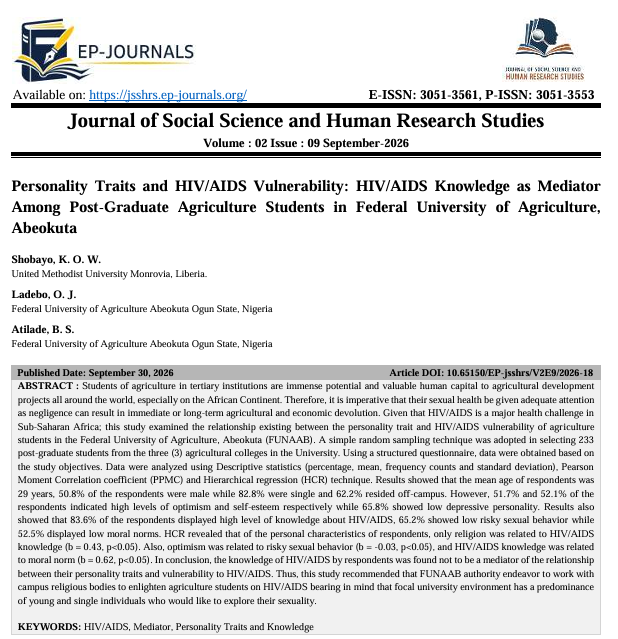
Personality Traits and HIV/AIDS Vulnerability: HIV/AIDS Knowledge as Mediator Among Post-Graduate Agriculture Students in Federal University of Agriculture, Abeokuta
DOI:
https://doi.org/10.65150/EP-jsshrs/V2E9/2026-18Keywords:
HIV/AIDS, Mediator, Personality Traits, and KnowledgeAbstract
Students of agriculture in tertiary institutions are immense potential and valuable human capital to agricultural development projects all around the world, especially on the African Continent. Therefore, it is imperative that their sexual health be given adequate attention as negligence can result in immediate or long-term agricultural and economic devolution. Given that HIV/AIDS is a major health challenge in Sub-Saharan Africa; this study examined the relationship existing between the personality trait and HIV/AIDS vulnerability of agriculture students in the Federal University of Agriculture, Abeokuta (FUNAAB). A simple random sampling technique was adopted in selecting 233 post-graduate students from the three (3) agricultural colleges in the University. Using a structured questionnaire, data were obtained based on the study objectives. Data were analyzed using Descriptive statistics (percentage, mean, frequency counts and standard deviation), Pearson Moment Correlation coefficient (PPMC) and Hierarchical regression (HCR) technique. Results showed that the mean age of respondents was 29 years, 50.8% of the respondents were male while 82.8% were single and 62.2% resided off-campus. However, 51.7% and 52.1% of the respondents indicated high levels of optimism and self-esteem respectively while 65.8% showed low depressive personality. Results also showed that 83.6% of the respondents displayed high level of knowledge about HIV/AIDS, 65.2% showed low risky sexual behavior while 52.5% displayed low moral norms. HCR revealed that of the personal characteristics of respondents, only religion was related to HIV/AIDS knowledge (b = 0.43, p<0.05). Also, optimism was related to risky sexual behavior (b = -0.03, p<0.05), and HIV/AIDS knowledge was related to moral norm (b = 0.62, p<0.05). In conclusion, the knowledge of HIV/AIDS by respondents was found not to be a mediator of the relationship between their personality traits and vulnerability to HIV/AIDS. Thus, this study recommended that FUNAAB authority endeavor to work with campus religious bodies to enlighten agriculture students on HIV/AIDS bearing in mind that focal university environment has a predominance of young and single individuals who would like to explore their sexuality.
References
1) Ackerman. P. L., Bowen, K. R., Beier, M. E. and Kanfer, R. 2001. Determinants of Individual Differences and Gender Differences in Knowledge. Journal of Educational Psychology. 93(4): 797-825.
2) Ajzen, I. and Madden, T. 1986. Prediction of Goal-Directed Behavior: Attitudes, Intentions, and Perceived Behavioural Control. Journal of Experimental Social Psychology. 22(5): 453-474.
3) Ajzen, I. 1992. A Comparison of the Theory of Planned Behaviour and the Theory of Reasoned Action. Personality and Social Psychology Bulletin. 18(1): 3-9.
4) Akpabio, I. I., Asuzu, M. C., Fajemilehin, B. R. and Ofi, A. B. 2009. Effect of School Health Nursing Education Interventions on HIV/AIDS-Related Attitudes of Students in Akwa Ibom State, Nigeria. Journal of Adolescent Health. 44(2): 118-123.
5) Albarracin, D., Johnson, B., Fishbein, M. and Muellerleile, P. 2001. Theories of Reasoned Action and Planned Behaviour as Models of Common Use: A Meta-Analysis. Psychological Bulletin. 127(1): 142-161.
6) Asante, K. O., and Oti-Boadi, M. 2013. HIV/AIDS Knowledge among Undergraduate Students: Implications for Health Education Programs in Ghana. Journal of African Health Sciences. 13(2): 270-277.
7) Avert. 2017. (UNAIDS/WHO,2005). Global Information and Education on HIV/AIDs.Bagozzi, 1981).
8) Bankole, M. O. and Abioye, A. 2017. Influence of Access to HIV/AIDS Information on the Knowledge of Federal University Undergraduates in Nigeria. Journal of Libri.2(68): 149-164.
9) Blanc, A. K. 2000. The Relationship between Sexual Behaviour and Level of Education in Developing Countries. Geneva, Switzerland, UNAIDS.
10) Carver, C. S. and Scheier, M. F. 2000. The Perspective of Personality. 4th Edition. Boston: Ally and Bacon.
11) Collins, J. and Rau, B. 2001. HIV/AIDS and Poverty – Food and Agriculture Organization of the United States of America. In: Mambo, P. 2017. Victims of Ignorance, Circumstance or Fate? Sub-Saharan and the HIV/AIDS Virus.
12) Colman, A. 2015. “Theory of Reasoned Action”. A Dictionary of Psychology.
13) Diclemente, R. J., Brown, L. K., Beausoleil, N. I. and Lodico, M. 1993. Comparison of AIDS Knowledge and HIV-Related Sexual Risk Behavior among Adolescents in Low and High AIDS Prevalence Communities. Journal of Adolescent Health.14(3), 231-236.
14) Doswell, W., Braxter, B., Cha, E. and Kim, K. 2011. Testing the Theory of Reasoned Action in Explaining Sexual Behaviour among African American Young Teens Girls. Journal of Pediatric Nursing. 5(4): 43-50.
15) FAO 2001, Press Release. HIV/AIDS Devastating Rural Labour Force in Many African Countries, Says FAO. May 10, 2001, Rome.
16) Federal Ministry of Health. 2010. National HIV Sero-prevalence Sentinel Survey Among Pregnant Women Attending Antenatal Clinics in Abuja, Nigeria.
17) Finlayson, A. E., Greaves, F. and Ali, F. R. 2012. Technologies for Global Health. Journal of The Lancet. 380(9855): 507-535.
18) Gallagher, N. G., South, S. C. and Oltmanns, T. F. 2003. Attentional Coping Style in Obsessive-Compulsive Personality Disorder: A Test of the Intolerance of Uncertainty Hypotheses. Journal of Personality and Individual Differences. 34(2): 41-47.
19) Gray, L. A and Saracino, M. 1989. AIDS on Campus: A Preliminary Study of College Students’ Knowledge and Behaviour.Journal of Counseling and Development. 68(2): 199-202.
20) Halder, S., Roy, A. and Chakraborty, P. K. 2010. The Influence of Personality Traits on Information Seeking Behaviour of Students. Malaysian Journal of Library and Information Science. 15(1): 41-53.
21) Hammond, C. 2017. Understanding Depressive Personality Trait. Psych Central (Online). Https://Pro.Psychcentral.Com/Exhausted-Woman/2015/10/Understanding-Depressive-Personality-Trait/. (Asccessed June, 2026)
22) Hicks, G., Barragan, M., Franco-Paredes, C., Williams M. V. and del Rio, C. 2006. Health Literacy is a Predictor of HIV/AIDS Knowledge. African Journal of Primary Health Care and Family Medicine. 38(10): 717-723.
23) HIV/AIDS (2016),
24) Human Science Research Council. 2001a. HIV/AIDS in Southern Africa: A Review Paper for The W.K. Kelloggs Foundation’, Unpublished Report by The Social Aspects of HIV/Aids and Health Programme For W.K. Kelloggs Foundation, October.
25) Jonsen, A. R and Stryker, J. 1993. Monitoring the Social Impact of the AIDS Epidemics: Social Impact of AIDS in the United States. National Academies Press, Washington DC.
26) Kelly, M., 2006. Education and AIDS: Are we too optimistic? Paper presented at the regional workshop on good practices in education sector responses to HIV and AIDS in Africa, Johnnesburg, South Africa, 12-14 September.
27) Keselman, A., Kaufman, D. R. and Patel, V. L. 2004. “You Can Exercise Your Way Out of HIV” and Other Stories: The Role of Biological Knowledge in Adolescents’ Evaluation of Myths. Journal of Science Education. 88(4): 548-573.
28) Larsen, R. R., and Buss, D. M. 2018. Personality Psychology: Domains of Knowledge about Human Nature 1-20pp.
29) Lovibond, S. H., And Lovibond, P. F. 1995. Mannual For the Depression, Anxiety and Stress Scales. (2nd Ed) Sydney: Psychology Foundation.
30) MacLachlan, E. W., Baganizi, E., Bougoudogo, F., Castle, S., Mint-Youbba, Z., Gorbach, P., Parker, K. and Ryan, C. A. 2002. The Feasibility of Integrated STI Prevalence and Behaviour Surveys in Developing Countries. Journal of Epidemiology and Community Health. 78(3): 187-189.
31) Moore, S., and Halford, A. P. 1999. Barriers of Safer Sex: Beliefs and Attitudes among Male and Female Heterosexuals across Four Relationship Groups. Journal of Health Psychology.4(2): 149-163.
32) Mufune, P. 2015. Poverty and HIV in Africa: Specifying the Connection. 13(1) pp1-29.
33) NACA. 2012. Global AIDS Response Country Progress Report. Federal republic of Nigeria.
34) NACA. 2017. National Strategic Framework on HIV and AIDS: 2017-2021.
35) Napoli, P. M. 2001. Consumer Use of Medical Information from Electronic and Paper Media. In: Rice, R. E. and Katz, J. E. (Ed), The Internet and Health Communication. Thousand Oaks, C.A: Sage, Pp 79-98.
36) Pellowski,J. A., Kalichman, S. C., Matthews, K. A. and Adler, N. 2013. A Pandemic of the Poor: Social Disadvantage and the U.S. HIV Epidemic. American Psychologist Journal. 68(4): 197-209.
37) Posner, S. F., Collins, L. M., Longshore, D., and Anglin, D. 1996. The Acquisition and Maintenance of Safer Sexual Behaviours among Injection Drug Users. Substance Use and Misuse Journal.31(14): 1995-2015.
38) Rogers, G.M., Archibald, M., Morrison, D., Wilsdon, A., Wells, E., Hoppe, M., Nahom, D. and Murowchick, E. 2002. Teen Sexual Behaviour: Applicability of the Theory of Reasoned Action. Journal of Marriage and Family. 64(4): 885-897.
39) Rosenberg, M. 1989. Society and the Adolescent Self-Image.Middletown, CT: Wesleyan University Press.
40) Scheier, M. F. and Carver, C. S. 1994. On the Power of Positive Thimking: The Benefits of Being Optimistic. Journal of Current Direction in Psychological Science. 2(1): 26-30.
41) Seal, D. W. and Agostinelli, G. 1994. Individual Differences Associated With High-Risk Sexual Behaviour: Implications for Intervention. AIDS Care Journal. 6(4): 393-397.
42) Swenson, R. R., Rizzo, C. J., Brown, L. K., Vanable, P. A., Carey, M. P., Valois, R. F., DiClemente, R. J. and Romer, D. 2010. HIV Knowledge and its Contribution to Sexual Health Behaviours of Low-income African American Adelescents. Journal of the National Medical Association. 12(102): 1173-1182.
43) Terry, D. J., Gallois, C. and Mccamish, M. 1993. The Theory of Reasoned Action: Its Application to Aids-Preventive Behaviour. Psychology Press. Pp 255.
44) Trobst, K. K., Herbst, J. H., Masters III, H. L. and Costa Jr, P. T. 2002. Personality Pathways to Unsafe Sex: Personality, Condom Use, and HIV Risk Behaviour. Journal of Research in Personality. 2(36): 117-133.
45) Umar, F. 2013. Personality Traits: Definition and Type of Personality Traits. 22pp UNAIDS, Country Progress Report (Nigeria UNGASS Report); 2007 Assessed from www.unaids.org (February, 2026).
46) UNAIDS, 2008. Who Is Being Infected With HIV And What Makes People Vulnerable To HIV Infections/ Risk and Vulnerability? HIV Prevention Toolkit. UNAIDS, Fact Sheet- Latest Statistics on the Status of the AIDS Epidemic (Global HIV Statistics);2017 Assessed From Www.Unaids.Org (February, 2026).
47) UNAIDS. 2017. HIV and AIDs in Nigeria. Global Information and Education on HIV and AIDs (AVERT).
48) Wingood G. M., Diclemente R. J., Mikhail I., Lang D. L. and Mccree D. H.. 2004. A Randomized Controlled Trial to Reduce HIV Transmission Risk Behaviours and Sexually Transmitted Diseases among Women Living With HIV: The Willow Program. Journal of Acquired Immune Deficiency Syndrome. 23(37): 58-67.
49) World Bank, 2002. Education and HIV/AIDS: A Window of Hope. Washington, D. C., USA.
50) Yamane, T. 1967. Statistics: An Introductory analysis, 2nd Edition, New York: Harper and Row. In: Otabor, J. A., and Obahiagbon, K. 2016. Statistical Approach to the Link between Internal Service Quality and employee Job Satisfaction: A Case Study. American Journal of Applied Mathematicis and Statistics. 4(6): 178-184.
51) Young, S. D., Rivers, C. and Lewis, B. 2014. Methods of Using Real-time Social Media Technologies for Detection and Remote Monitoring of HIV Outcomes. Journal of Preventive Medicine. 63; 112-115.
Downloads
Published
Issue
Section
License
Copyright (c) 2026 Shobayo, K. O. W., Ladebo, O. J. , Atilade, B. S. (Author)

This work is licensed under a Creative Commons Attribution 4.0 International License.